
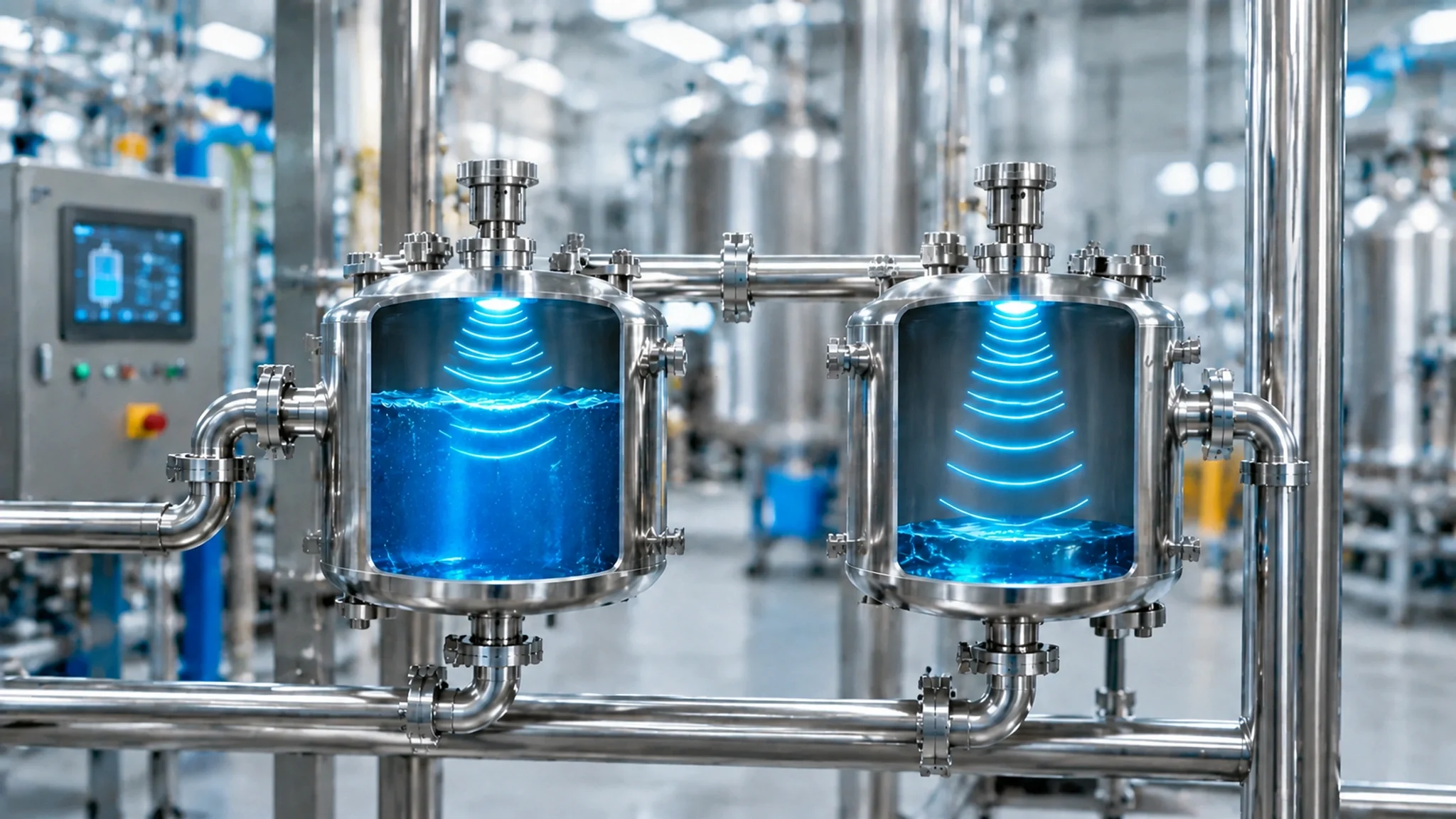
Marginal levels instead of continuous measured values
In filling processes, the information of whether a container is sufficiently filled, overfilled or empty can be sufficient. Two limit levels are defined for this task: a lower limit for the minimum fill level and an upper limit for the maximum fill level. The area in between corresponds to the intended filling window. This makes it possible to check whether the filling is in order after filling without having to continuously evaluate the contents in milliliters or millimeters.
Non-contact testing is particularly suitable if no sensor is to come into contact with the medium or if changing colors and transparencies make optical detection difficult. Depending on the process, the same logic can also be used for point level monitoring in storage containers.
Distinguishing three states with two switching points
In the test setup, the ultrasonic distance sensor is mounted U1KT001 above an open glass container. The sensor measures the distance to the nearest reflective surface. If the level rises, the measured distance between the sensor and the liquid surface is shortened. The two independently adjustable switching outputs map the lower and upper fill level limits. Three relevant states can be derived from their combination: empty or below the minimum fill level, within the permissible range and at or above the maximum fill level.
| Condition | Distance in the test | Rating |
|---|---|---|
| Empty container | 232 mm | Below the minimum fill level |
| Minimum fill level | 190 mm | Lower limit reached |
| Maximum fill level | 150 mm | Upper limit reached |
The test values refer to the structure shown. The distance between the sensor and the table top is 236 mm.
Why ultrasound offers advantages for changing media
Ultrasonic sensors emit sound pulses and determine the distance based on the travel time of the reflected signal. This means that the detection does not depend on the color or transparency of a liquid. Changing media can also be monitored with the same measurement method, provided that their surface sufficiently reflects the sound back to the sensor. Vapor, dust and extraneous light also have a much smaller influence on the measuring principle than many optical methods. For a stable measurement, however, the container geometry, the orientation of the sensor and possible foaming or strong movements of the liquid surface must be taken into account. The specific installation situation should therefore be checked with the containers and media used later.
Compact miniature sensor for different container sizes
The U1KT001 operates in tactile mode in a range of 30 to 400 mm and has two independently parameterizable switching outputs. This means that both limit values can be monitored with just one sensor. The miniature design of 32 × 16 × 12 mm facilitates integration in limited installation space. The switching points and other sensor parameters can be adapted to the respective container size and the desired filling range via IO-Link.
The test setup uses the available measuring range for clearly separated states: There are 42 mm between the empty container and the minimum fill level, and a further 40 mm between the minimum and maximum fill levels. In practice, however, it is not these absolute values that are decisive, but the limit levels defined to suit the application.
Point level control or continuous level measurement
Whether two switching points are sufficient depends on what information the process requires. For a good-bad decision after filling or min-max monitoring, the U1KT001 with its two switching outputs is suitable. If, on the other hand, the actual fill level is to be continuously transmitted to a controller, a sensor with analog measured value output is the more suitable solution. Within the same design, the U1KT006 offers an analog output from 0 to 10 V as well as IO-Link. This allows the measured distance to be processed as a continuous value and converted into a fill level if the container geometry is known. In the case of small container openings, a sound pipe can also be used to guide the sound beam in a targeted manner.
Monitor two limit values with one sensor
The contactless min-max control reduces the task to the conditions that are actually relevant to the process. Two switching points are sufficient to distinguish between an empty or underfilled container, the permissible filling range and the reaching of the maximum fill level. At the same time, the solution remains flexible because the limit values can be adapted to other containers or fill levels without mechanical intervention.


