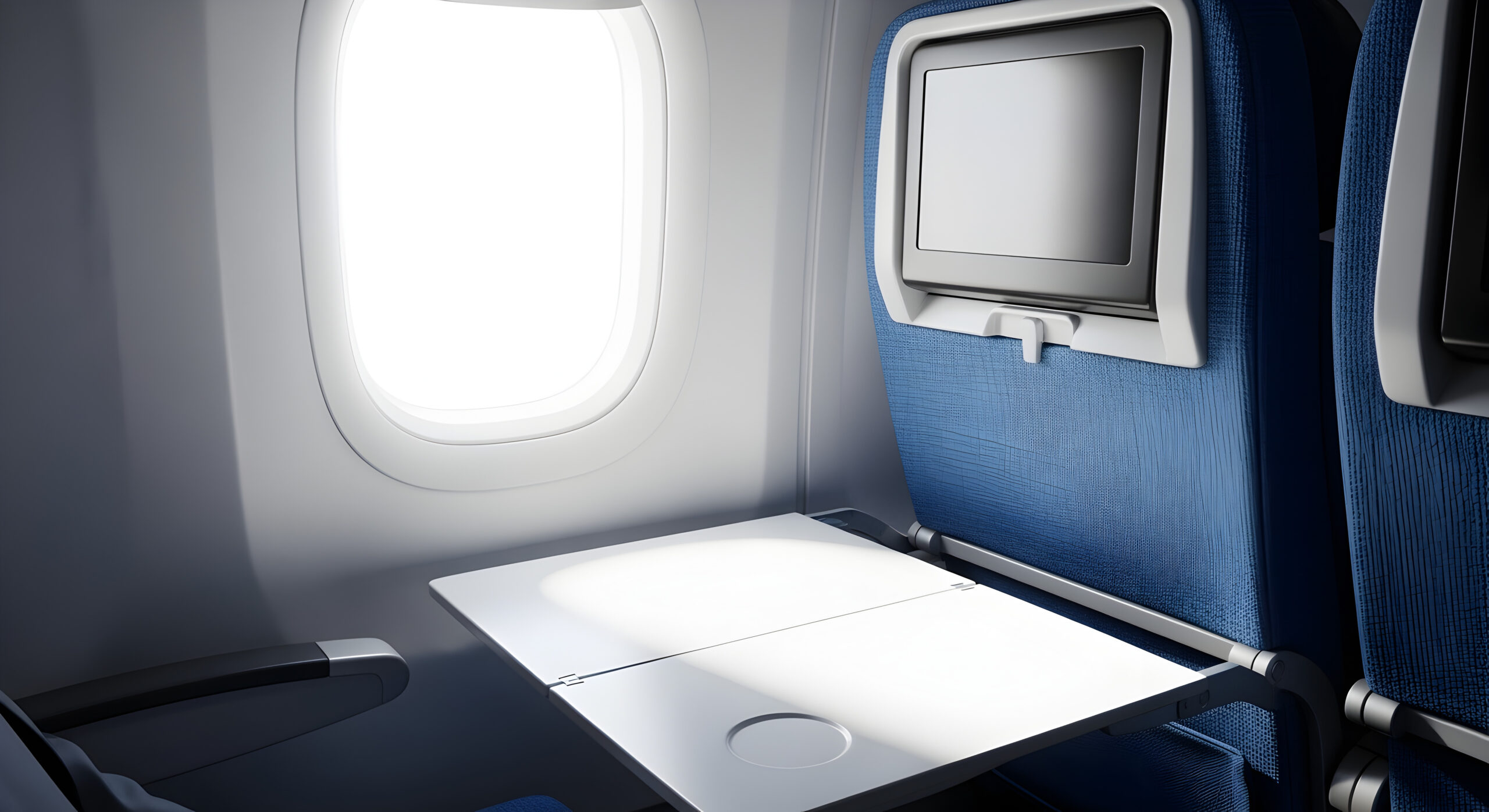
A customer inquiry reached wenglor regarding the introduction of a new, non-contact measuring technology in the final assembly of aircraft seats. Specifically, the inclination of a hinged table on the backrest of a seat was to be checked and adjusted. The table must be precisely aligned to an angle of 3° – a requirement that demands high precision and at the same time easy handling for the workers.
The challenge in final assembly
In previous practice, such angles were often checked mechanically or with manual aids. However, the customer was looking for a solution that works without contact, delivers reproducible results and makes the measured values directly visible. The idea was not to measure the angle directly, but to record the height of the table. If the heights are determined at several points, the position of the table and thus the inclination angle can be clearly calculated.
In addition, the measurement was to be visualized in real time so that the worker could immediately align the table correctly. At the same time, documentation of the measurement results was required in order to verify the quality of the assembly process.
The solution: profile sensors for angle measurement
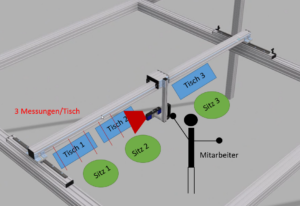
The sketch shows the installation of the MLSL226 profile sensor on an aircraft seat folding table. The sensor detects the table surface at several points in order to precisely determine the inclination angle.
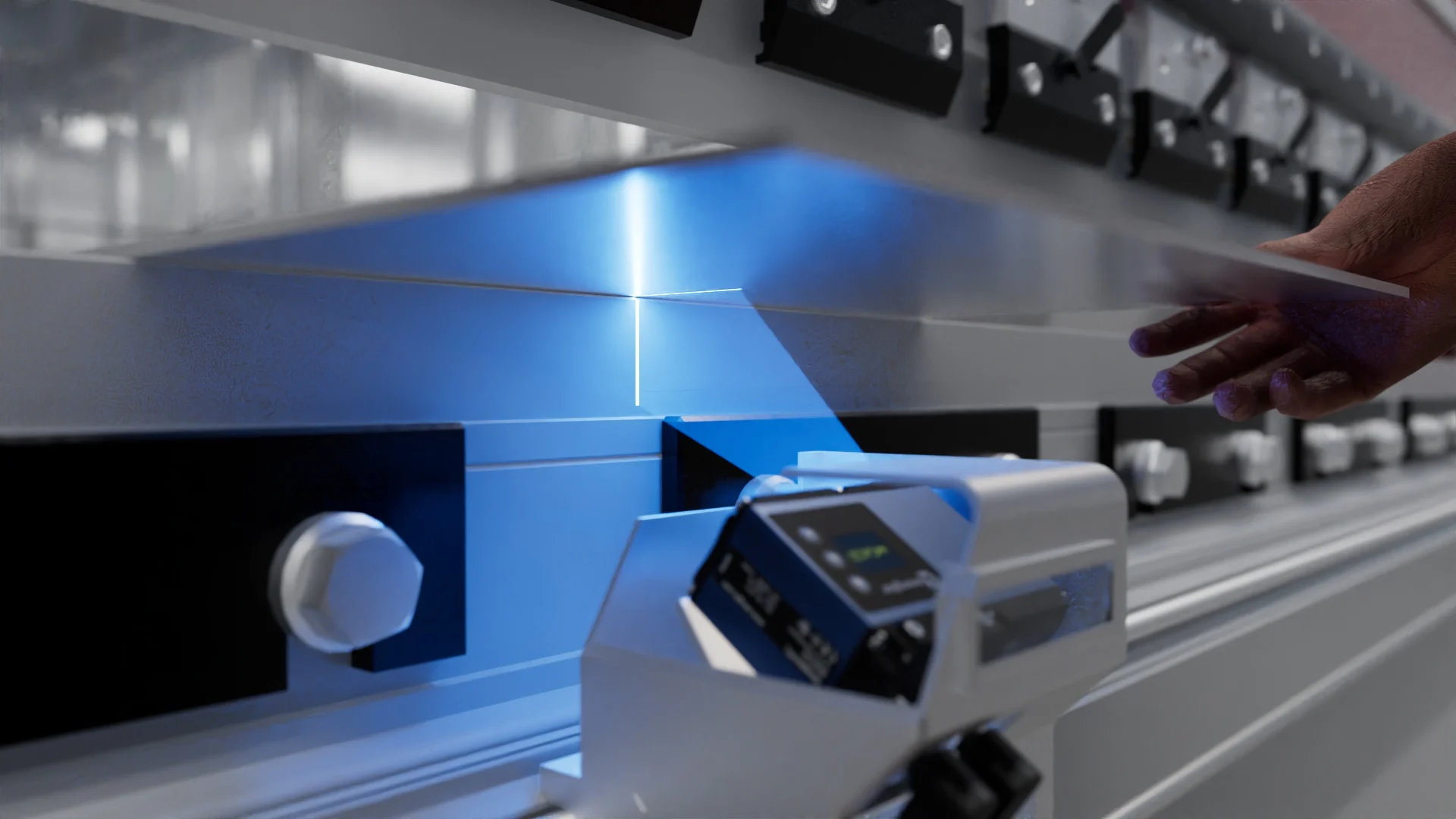
The use of 2D/3D profile sensors from the MLSL series is ideal for this application. The MLSL226 is used in the actual implementation. The sensor projects a laser line onto the table surface and generates a precise height profile using the triangulation principle. The inclination angle can be reliably calculated from this profile.
There are typically three to four seats in a row, each with a folding table. After installation, the MLSL226 is moved manually over each table, guided by a handle on the side. Three measurements are taken for each table: left, center and right. The angle is determined from these three profiles. If this deviates from the target value, the system immediately generates an N.O.O. signal.
Semi-automated and flexible implementation
The solution is deliberately designed to be semi-automated. As table types can differ depending on the batch, manual movement to the measuring positions is practical and flexible. At the same time, employees benefit from significantly higher measuring accuracy and shorter inspection times compared to purely manual processes.
The measuring frequency of the MLSL226 in Smart mode is around 175 to 200 measurements per second, which is perfectly sufficient for this application and enables a smooth, stable display of measured values.
Smart operation without additional analysis module
A significant advantage for the customer is the smart operation of the profile sensor. With the DNNL015 license key, evaluation takes place directly on the sensor itself. An additional control unit (IPC) is not required. This not only reduces hardware costs, but also leads to considerable cost savings and simplifies system integration.
Direct visualization for the worker
The measurement results are provided via a web-based visualization. This can be displayed on a tablet, for example, and clearly shows the worker whether the table is set correctly or needs to be readjusted. This provides intuitive support for the adjustment process and at the same time enables complete documentation of the measured values.
Conclusion
With the MLSL profile sensor, the inclination angle of aircraft seat folding tables can be measured precisely, non-contact and user-friendly. The combination of height profile measurement, smart evaluation directly in the sensor and real-time visualization ensures faster assembly processes, greater accuracy and sustainable quality assurance in final assembly.
Learn more about MLSL profile sensors