Three states instead of a simple yes-no check
On an older bottling line, beverage crates with twelve standard fountain bottles each are transported. Five existing optical sensors are to be replaced as part of a retrofit. Their original task was to check the bottles for an existing lid before further transport. The switch from aluminum lids to plastic lids in different colors is increasingly leading to incorrect switching. The new sensor solution should therefore not only work independently of the lid color. It should also provide more information about the condition of the bottle.
In a test setup, it was tested whether three states could be clearly distinguished from each other with an ultrasonic sensor:
| Condition of the bottle | Switching Output Response | Significance for the control system |
|---|---|---|
| Lid available | Switch both outputs | Bottle is present and closed |
| No lid, bottle full to the brim | One output switches | Bottle is available, the lid is missing |
| No lid, bottle not fully filled | No output switches | Bottle is not properly closed and filled |
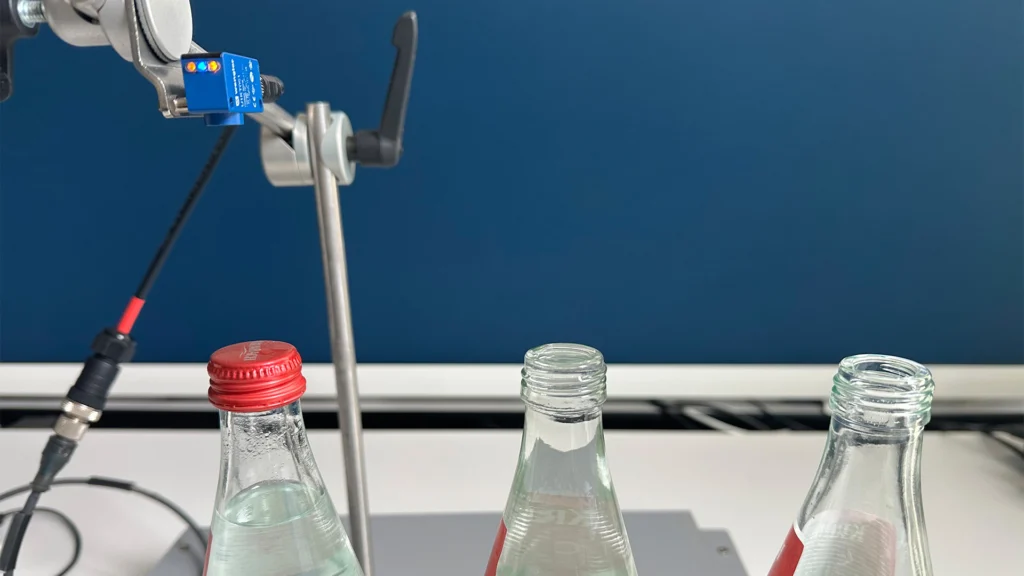
A pure lid inspection is thus transformed into a compact three-condition test. The control system can not only detect a missing cap, but also distinguish between an open bottle that is full to the brim and an open bottle that is not completely filled.
Only 1.5 mm separates lid and bottle neck
The distance between the sensor and the top of the bottle is about 80 to 100 mm. At the same time, the height difference between a closed bottle and the open bottle mouth is only about 1.5 mm. The sensor must reliably detect this small difference, even though different lid colors and materials run through the system. This is challenging for an optical button. Depending on the color, material and surface finish, the proportion of returning light changes. Changing from metallic to different colored plastic lids can thus influence the switching behavior. In addition, there is the open glass bottle mouth, which must not be accidentally recognized as a cap if the lid is missing.
Ultrasonic makes the inspection independent of the lid color
The ultrasonic distance sensor U1KT001 was used for the experiment. The sensor emits ultrasonic waves and evaluates the sound reflected by the object. This means that the detection does not depend on the color of the lid.
In the test, both aluminum lids and differently colored plastic lids were recorded. The decisive factor is the respective distance to the reflective target: The lid, the surface of an open bottle filled to the brim and a deeper liquid surface create different distance situations. The first video shows the inspection of different bottle positions within the beverage crate. The sensor distinguishes between a bottle with a lid and an open bottle.
The working range of the U1KT001 is between 30 and 400 mm in tactile mode. With a resolution of 0.5 mm, the sensor can detect subtle changes in distance. However, whether a stable switching state can be derived from this also depends on the parameterization, the position of the bottle and the tolerances of the system.
Two switching outputs directly map the test logic
The U1KT001 has two independently adjustable switching outputs. This allows two distance ranges to be defined without the control system having to continuously evaluate an analog measured value. With a closed bottle, both outputs react. If the lid is missing, the reflective surface is further away from the sensor. With an open bottle full to the brim, only one of the two outputs switches. If the liquid surface is even lower, this output also remains inactive. It is not important which connection is referred to as the “first” or “second” output. What counts for the PLC is the unique combination of the two signals. It can be directly translated into three test decisions.
Both outputs: lid available
One outlet: open, brimming bottle
No output: open, not fully filled bottle
In the second video, the three states are checked one after the other. You can see a closed bottle, an open bottle full to the brim and an open bottle that is only partially filled. The sensor’s switching status indicators make the respective output combination visible.
The bottle mouth must not produce a false signal
In the case of an open glass bottle, part of the sonic beam may hit the edge of the mouth. In the test, this did not lead to a short false signal. The glass bottle mouth was not interpreted as an existing lid. At the same time, the transparent water surface of an open bottle full to the brim could be detected. This combination in particular is crucial for the application: The sensor should detect a plastic or aluminum lid, but not react to the rim of the glass if the lid is missing. If the open bottle is full to the brim, the liquid surface serves as a reflective target for the second test state instead.
The parameterization decides on the small height difference
With a difference of only 1.5 mm, the switching points must be closely matched to the application. The U1KT001 can be parameterized via IO-Link. Among other things, the filter, sound lobe, operating mode and teach mode can be adjusted.
In the test, the sonic beam was matched to the bottle mouth and the switching hysteresis was reduced as much as required for the application. In this way, even very small differences in height could be detected. However, the settings should not be transferred unchanged to each filling line. Fluctuating bottle heights, the position within the crate, conveying movements and the distance to the sensor influence the available process window.
For commissioning, it is therefore advisable to teach in all relevant conditions with the bottles, lids and fill levels actually used and then check them across several crates.
Compact solution for retrofitting
The miniature design of the sensor makes it easier to replace it in the existing system. The U1KT001 measures 32 × 16 × 12 mm and is connected via an M8 connector. With IP68 protection, the housing is also suitable for demanding environmental conditions. The combination of compact design and two switching outputs is particularly relevant for the retrofit. It enables extended test logic without having to install a separate sensor for each condition. At the same time, the detection remains independent of whether aluminum lids or plastic lids of different colors run through the system.
The lid check becomes a condition check
The use of ultrasound solves two problems at the same time in this application: different lid colors do not affect detection, and two separate switching points allow for more differentiated control. This allows the system to determine whether a bottle is closed, open and full to the brim, or open and not completely filled.
The test shows that even the small height difference of around 1.5 mm can be used for the test. The prerequisites for this are a suitable installation position, a sound beam matched to the bottle mouth and careful parameterization with the real bottles and lids.