In research environments, robotics laboratories and special machine construction, measurement tasks are not always permanently part of a system. It is often a matter of checking movement paths, checking distances or reconstructing positions – for example during test setups, calibrations or process optimization. In such situations, it is not a permanently integrated sensor solution that is required, but a system that can be used flexibly and removed just as quickly.
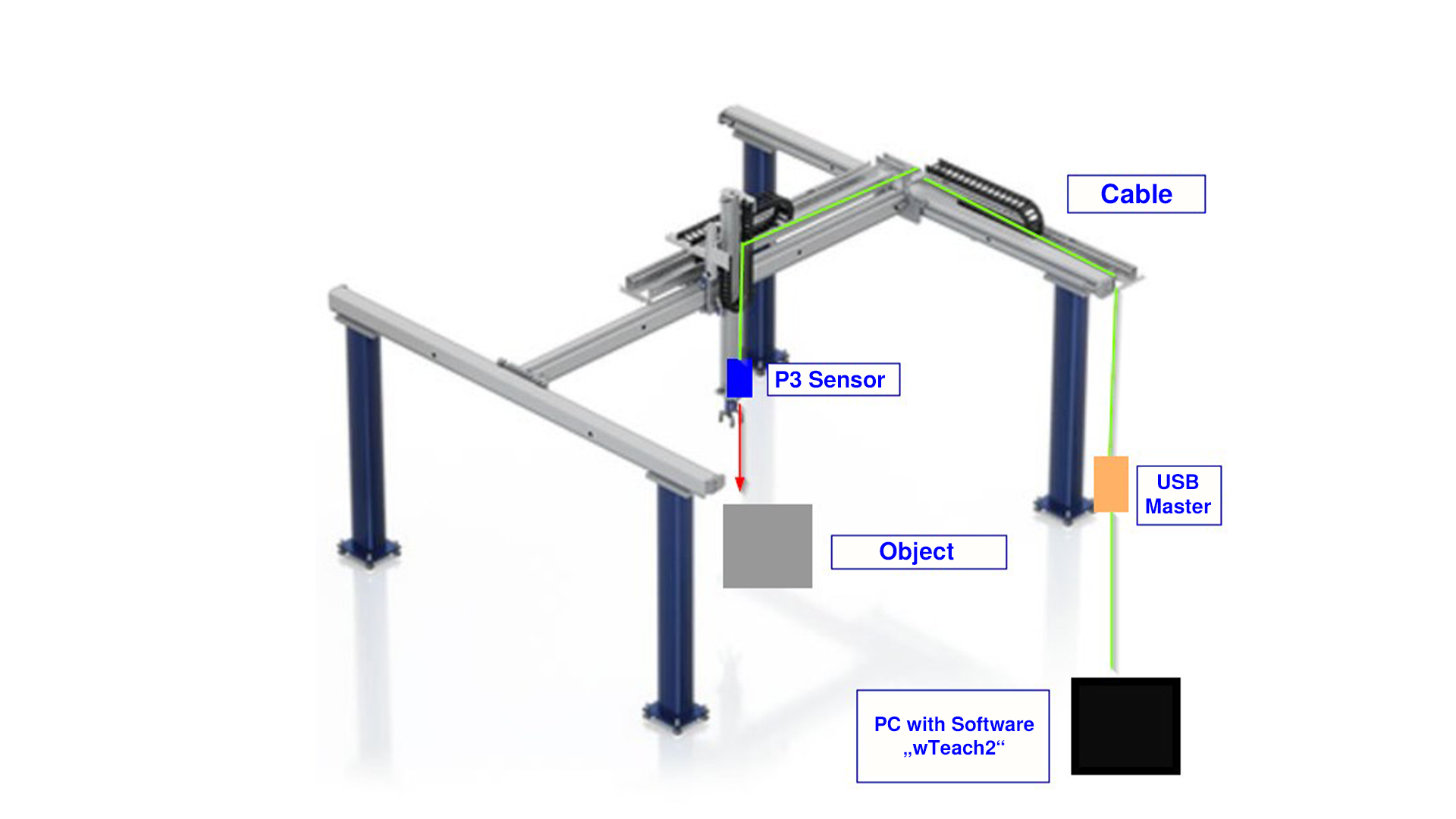
A mobile distance measurement system was implemented precisely for such an application. If necessary, a sensor is mounted on a surface gantry robot, measures distances to a component and transmits the measured values directly to a laptop.
The task: To track distances in the large workspace
A gantry robot with a working area of several square meters should be checked on the sensor side. The aim was to record the distance to a component in order to be able to better analyze movement sequences and positions. The sensor was not to be permanently integrated into the system, but to serve as a temporary test device. The decisive factor was that the solution remains mobile and works without interfering with the existing control system. At the same time, it should be possible to visualize and evaluate the measured values directly on the PC.
A classic, permanently installed sensor system would not have met these requirements. Instead, a flexible measuring tool was required that could be quickly assembled, used and dismantled again.
The solution: sensors for mobile distance measurement
A laser distance sensor is used, which is connected via IO-Link. In combination with a USB-IO-Link master, a direct connection to the laptop is created. The sensor detects the distance, the IO-Link master transmits the data via USB, and the software displays the measured values in real time.
This turns a single sensor into a complete mobile measuring system. The sensor can be attached to the gantry robot, the measurement is taken during movement, and the data is immediately available. After completion of the test, the sensors are removed again without the need to make changes to the machine control.
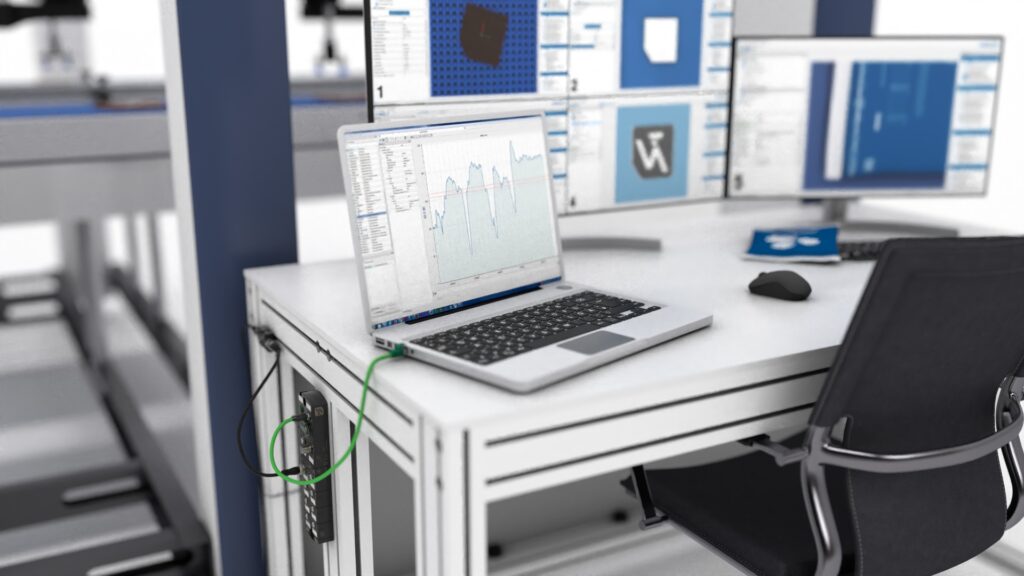
Make measured values visible – directly on the PC
A major advantage of this solution is the direct visualization of the measured values. The software can be used to display distance values live and observe them over time. This makes movement sequences and changes in position transparent. In addition, measurement data can be stored and further processed, for example for documentation or analysis.
This option is crucial, especially in research and development environments. Measurements can be evaluated immediately without having to rely on a higher-level controller or additional evaluation hardware.
Why this concept is so flexible
The system shows how sensor technology can also be used beyond classic machine integration. Instead of permanently installed components, a mobile testing tool is created that is only used when it is needed. Sensor, connection technology and software form a coordinated unit that works independently of a machine control system.
The robust design of the sensor is another advantage, as it is mounted and disassembled more frequently. At the same time, the digital connection via IO-Link ensures that measured values can be transmitted precisely and parameters can be easily adjusted.
Typical applications of mobile distance measurement
Such mobile measurement solutions are useful wherever sensor technology is only needed temporarily. This applies, among other things, to the calibration of robots, the verification of travel paths, test setups in laboratories or quality controls at changing positions. Sensors can also be used in retrofit or analysis projects without being permanently integrated into the system.
Conclusion
Not every measurement task requires a permanently installed sensor solution. Mobile sensor systems with laser distance sensor, IO-Link and PC connection offer a flexible way to precisely check distances and movement paths. Especially in research, robotics and special machine construction, this creates a versatile testing tool that can be used exactly where it is currently needed – and then disappears again.